

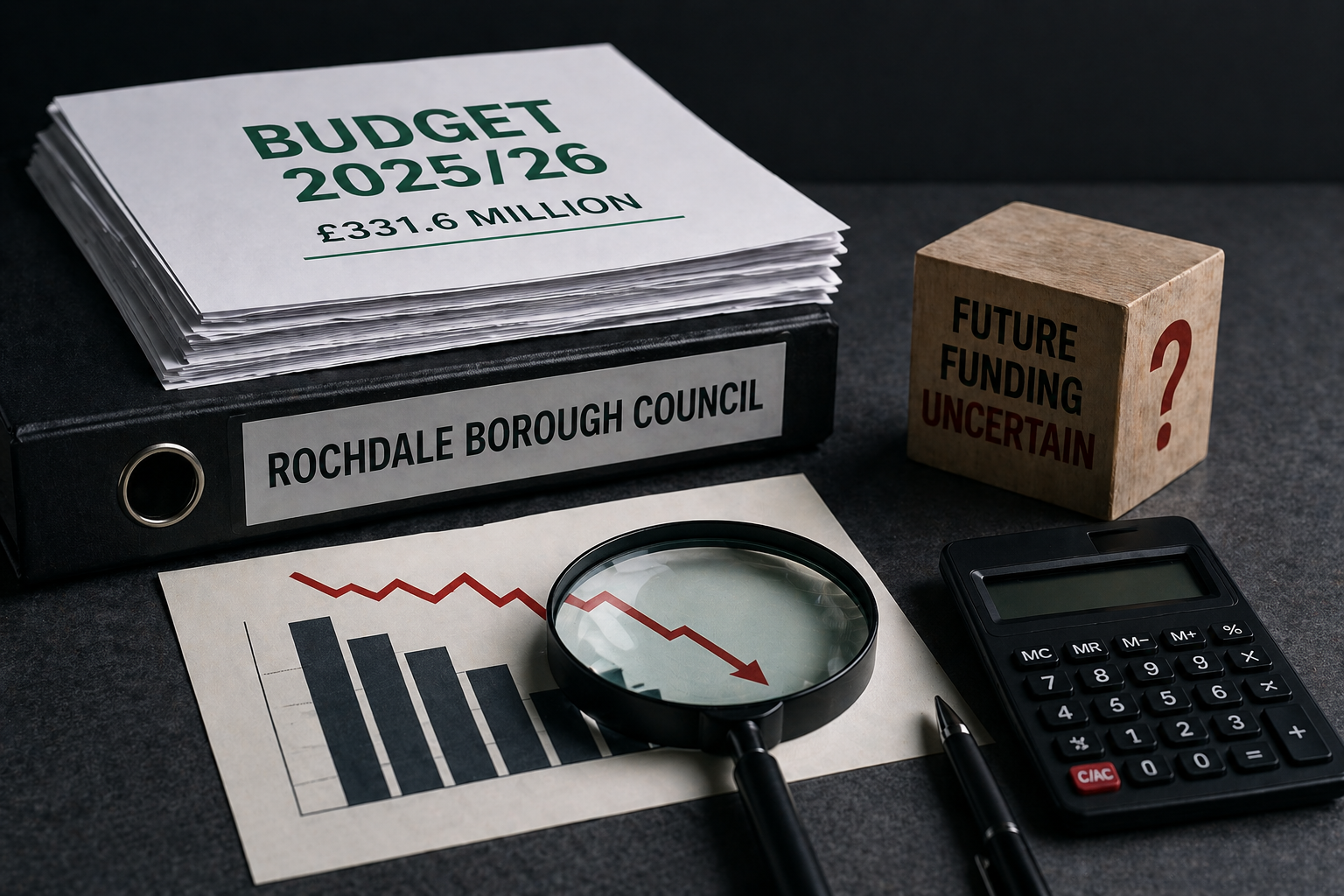
When Rochdale Borough Council announced a £31 million budget increase—rising from £300.6 million in 2024/25 to £331.6 million in 2025/26—it presented the move as stabilisation.
A 10% budget increase in a single year demands scrutiny. What the council was actually announcing was not improved services, but deepening financial strain.
The increase reflects a simple, troubling reality: spending is rising because demand is rising faster than income. This is not investment. It is crisis management dressed as growth.

Social care dominates both years' budgets and reveals the true pressure point. Children's services were forecast to overspend significantly in 2024/25. By 2025/26, both children's and adult services are projected to consume more resources than anticipated. The council acknowledges "significant pressures" in both sectors, driven by increased demand for placements, more complex cases requiring specialist care, and rising staffing costs.
Additional funding has been allocated. Demand has outpaced it anyway. This is not a temporary problem. It is structural.
The most revealing aspect of the 2025/26 budget is the introduction of a £7.8 million Recovery Grant. This funding is officially designated as a one-year allocation. Yet the council's budget projections assume it will continue beyond 2025/26.
If that assumption fails—and government grants are routinely withdrawn or reduced—Rochdale faces an immediate £7.8 million shortfall from 2026/27 onwards. This is not prudent financial planning. It is a structural dependency on money the council cannot guarantee will arrive.
To manage mounting pressures, Rochdale is increasingly drawing on reserves. A new "Growth Reserve" is being created using the Recovery Grant. Existing reserves are being deployed to offset social care pressures that show no sign of easing.
Reserves are finite. They can only be spent once. Using reserves to manage recurring pressures is a known strategy in local government—it defers crisis, it does not resolve it. The same pressures will return.
Residents are being asked to absorb more of the shortfall. The Band D council tax rate rose from £1,960.99 in 2024/25 to £2,058.84 in 2025/26—a 4.99% increase, continuing a pattern of near-maximum rises year on year.
These increases are within government-imposed limits. They also represent a clear pattern: local taxation is increasingly plugging funding gaps rather than funding improvements or expansion. Rochdale is asking its residents to pay more because the council cannot balance its books through service efficiency or demand management.
Beyond 2025/26, the council's own figures show a £1.6 million projected gap for 2026/27 and a £7.7 million projected gap by 2027/28. These are not guesses. They are based on known cost trajectories, anticipated social care demand, and assumptions about government funding.
The council's own assessment labels these projections as carrying "a high degree of risk." That phrase means the shortfalls could be worse.
Taken together, Rochdale's two consecutive budgets reveal a council trapped in a cycle: demand in core services, especially social care, rises year on year. Government funding does not keep pace. Council tax is increased near its legal maximum. One-off grants are assumed to be permanent. Reserves are deployed to bridge the gap. The cycle repeats.
This pattern is not unique to Rochdale. Across England's local authorities, the same pressures exist. But locally, the arithmetic is unforgiving.
The 2025/26 budget achieves balance through a combination of increased funding, council tax rises, one-off grants, and reserve usage. It is a carefully constructed equation that works—for now.
But the underlying drivers of cost remain unchanged. Social care demand will not stabilise. Government funding remains uncertain. The one-year Recovery Grant may or may not be renewed.
When these factors align, as they inevitably will, Rochdale will face a choice: deeper service cuts, further council tax rises, or both.
The question is no longer whether a financial crisis exists. The question is when the temporary measures currently holding the budget together will no longer be sufficient.